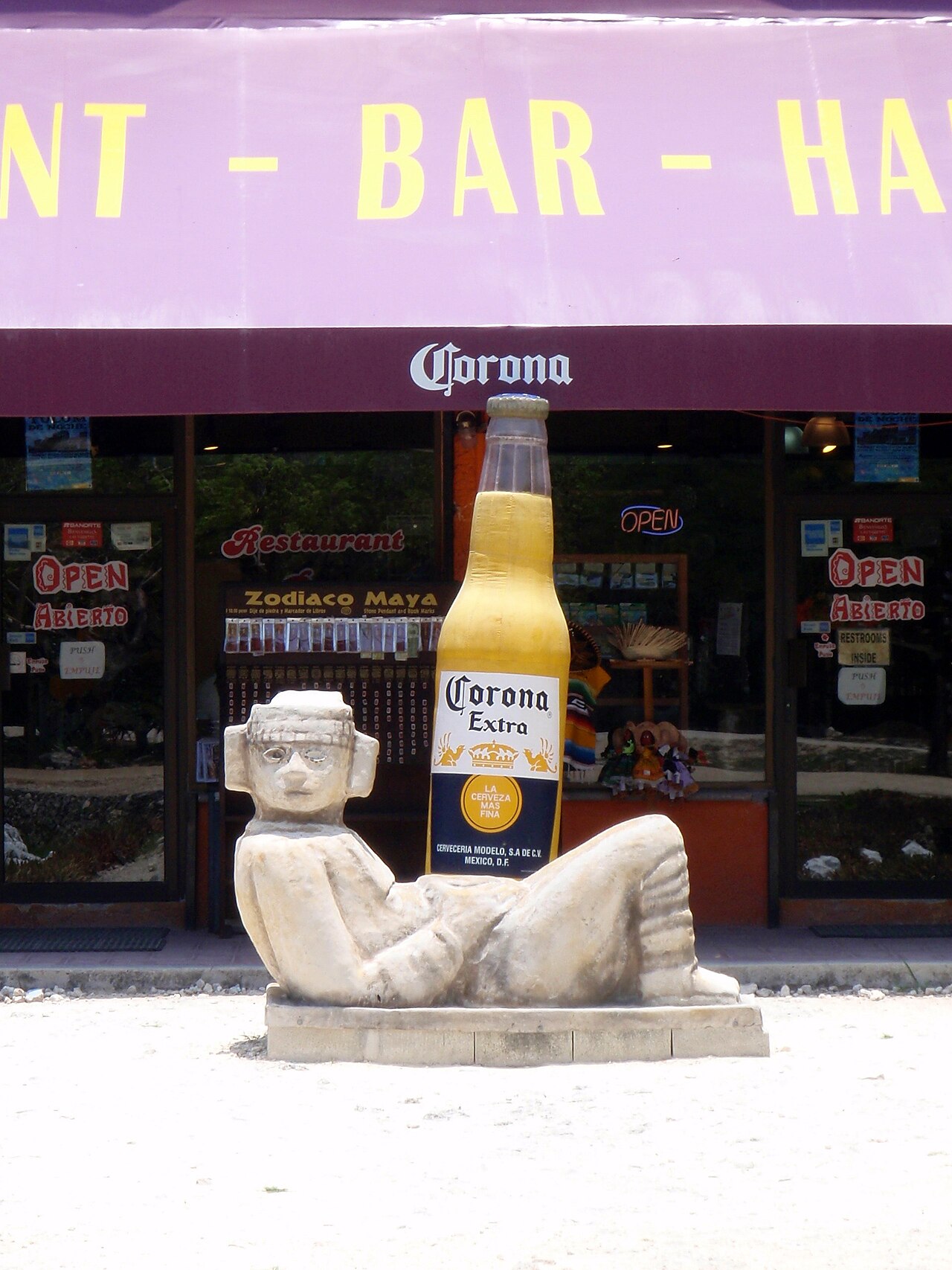
The story
Updated
Corona is a pale Mexican lager, first brewed in Mexico City in 1925, that has grown into the most valuable beer brand on earth. It is sold in more than 180 countries, poured over ice buckets on every warm coastline, and recognised at a glance by three things: a clear glass bottle, a painted blue-and-white label, and a wedge of lime pushed through the neck. This is how a city lager from post-revolutionary Mexico became the world's beach beer.
A brewery for a new Mexico
Cervecería Modelo opened its Mexico City brewery in 1925, in a country rebuilding itself after a decade of revolution. Corona was on its books from that first year, conceived as a clean, light-drinking lager for a hot climate and named for the Spanish word for crown — the crown that still sits on the label. The company drew on the wave of European brewing knowledge that had washed into Mexico in the late nineteenth century, when German and Austrian brewers planted Vienna-style lagers across the country.
Under Pablo Díez Fernández, the Spanish-born businessman who came to lead Grupo Modelo for decades, the young brewery consolidated aggressively and made Corona its spearhead. Within a generation the beer was among Mexico's best sellers; in the decades that followed it became the country's default lager, and Grupo Modelo grew into one of the largest brewers in the Americas, with plants far beyond the capital.

The bottle that refused a label
Corona's clear flint-glass bottle was a deliberate act of confidence. Where almost every brewer hides its beer behind brown glass — which blocks the light that skunks hops — Modelo wanted drinkers to see exactly what they were buying: a brilliantly pale, filtered lager. Instead of a paper label that would peel off in an ice bucket, the brand's crown and name are fired onto the glass itself as a painted, permanent label. The bottle became the brand. It survives ice, sand, and salt water, and it made Corona instantly recognisable from across any bar in the world.


Crossing the border
Corona reached the United States at the end of the 1970s and detonated through the 1980s. It arrived not as a premium European import but as something new: a beer that tasted like a holiday. Surf shops, college towns, and Sun Belt bars adopted it first, and by the mid-1980s Corona was the fastest-growing imported beer the US market had ever seen. Not everyone welcomed it — at the height of the boom a rumour campaign, traced back to a rival's distributor, claimed the beer was contaminated; Corona's importer answered with a lawsuit, won a public declaration that the beer was clean, and the boom rolled on. In 1997 Corona passed Heineken to become the best-selling imported beer in the United States, a title it held until its own stablemate, Modelo Especial, finally swept past it.
The machinery behind the boom was unglamorous and brilliant: two regional importers — Barton Beers working the western states from Chicago, Gambrinus the east from San Antonio — built the brand bar by bar, keeping the price above domestic lagers so that the clear bottle read as a small luxury rather than a cheap one. Constellation Brands bought Barton in 1993, and from 2007 its Crown Imports joint venture with Modelo ran the brand across the whole country, which is why, when regulators forced AB InBev to divest in 2013, Constellation was the buyer that already knew the business from the inside. The lesson Corona taught the industry stuck: imports do not have to chase the local taste. Sell the place the beer comes from, and the beer follows.
The lime ritual
Nobody can prove where the lime came from, and the brand has been happy to keep it that way. One story says a California bartender wedged a lime into the neck in 1981 to win a bet about starting a trend; others point to older Mexican cantina habits of taking lager with lime and salt, or to the practical business of wiping the bottle mouth clean. What matters is what the ritual became: a tiny ceremony that turns opening a beer into the start of a holiday. The squeeze, the push, the fizz — Corona owns a gesture, which is a rarer asset than any advertising line.
In Mexico, it should be said, plenty of drinkers skip the lime entirely, or reserve it for the michelada treatment of a different beer altogether; the neck-wedge is above all an export ritual, sold back to the world so successfully that bars from Sydney to Stockholm treat it as law. Corona leaned into it without ever quite explaining it — the advertising simply shows the lime falling, in slow motion, into a bottle in front of an empty horizon.
One brand, two owners
In 2013 Anheuser-Busch InBev completed its roughly 20-billion-dollar takeover of Grupo Modelo — and immediately had to give the crown jewel away in its biggest market. To satisfy US antitrust regulators, the American rights to Corona and the rest of the Modelo portfolio were sold to Constellation Brands, along with a brewery at Piedras Negras on the Texas border, for about 4.75 billion dollars. The result is one of the strangest arrangements in global consumer goods: Constellation owns and brews Corona for the United States, while AB InBev owns it everywhere else. Two rival companies now spend fortunes polishing the same crown, and the beer Americans drink is still brewed in Mexico.

Finding its beach
Corona's marketing has told one story with unusual discipline for four decades: the beach. Not a specific beach — the one in your head. The US campaign that ran from 2010 said it outright, 'Find Your Beach', and its successors, from 'This Is Living' to 'La Vida Más Fina', are variations on the same promise of unhurried life outdoors. The discipline was tested in 2020, when a novel coronavirus gave the brand's name a grim echo and pub closures hammered beer sales everywhere. The name survived the coincidence; within two years Corona was growing strongly again almost everywhere it is sold, with markets like China and Brazil pulling hardest.

Corona in 2026
A century after its first brew, Corona sits where no Mexican consumer brand has sat before. Kantar's BrandZ study ranks it the world's most valuable beer brand, a title Brand Finance's rival league table also hands it, and Kantar counts it Mexico's most valuable brand of any kind. Its alcohol-free sibling, Corona Cero, fronts AB InBev's worldwide Olympic partnership and poured through the Paris 2024 Games and the Milano Cortina Winter Games this February. The family around the flagship keeps widening — Corona Familiar in the big returnable bottle, Corona Light for the US, and a string of local editions across Asia and Latin America — but the centre never moves.
The product itself has barely changed in a hundred years, and that is the point. Corona is a pale, light, unapologetically simple lager, brewed to be drunk cold, outside, ideally within sight of water. Almost everything else about the beer business has been reinvented around it — ownership, marketing, formats, whole categories rising and falling — while the beer in the clear bottle stayed still and let the world come to it, still wearing its crown on painted glass.
What it tastes like
Corona is brewed to disappear pleasantly: brilliant pale gold, a light body, soft carbonation, and a faint sweetness of corn and grain over the gentlest hop bite. Served warm in a dark room it has little to say — this is a beer engineered for cold, sun, and salt air, where its lightness becomes the point. The lime is not decoration: its acidity sharpens the finish, covers any light-struck edge from the clear glass, and turns a very simple lager into a very specific ritual.
More beer brands
The Top 50 →Sources & corrections
Sources: ab-inbev.com · corona.com · inside.beer · ab-inbev.com · brandfinance.com · finance.sina.com.cn · barthhaas.com · wikidata.org
Structured data: Wikidata (CC0), Open Brewery DB (MIT), OpenStreetMap (© OpenStreetMap contributors, ODbL).
OnlyBeer is an independent beer atlas and is not affiliated with the entities shown. Facts are researched and sourced; images carry their license credits. Spot an error or want something updated or removed? Write to corrections@onlybeer.app— we act on it.